







Just a few years ago, the sight of a green padlock in the browser address bar was a welcome addition, associated primarily with banking and large online store websites. Today, the situation is dramatically different. The "Not Secure" message displayed by modern browsers for non-HTTPS website addresses has become a digital warning sign. In this context, the question posed in the title becomes largely rhetorical. SSL certificate has ceased to be an option and has become an absolute standard and the foundation of a secure Internet.
Lack of adequate security is no longer just an image issue, but a real threat to your users' data and a serious barrier to business development. It negatively impacts customer trust, search engine visibility, and the ability to use modern web technologies. In this comprehensive article, we'll explain exactly what an SSL certificate is, why having one is essential, the different types, and the risks you face by ignoring this crucial element of any professional website.
What exactly is an SSL certificate?
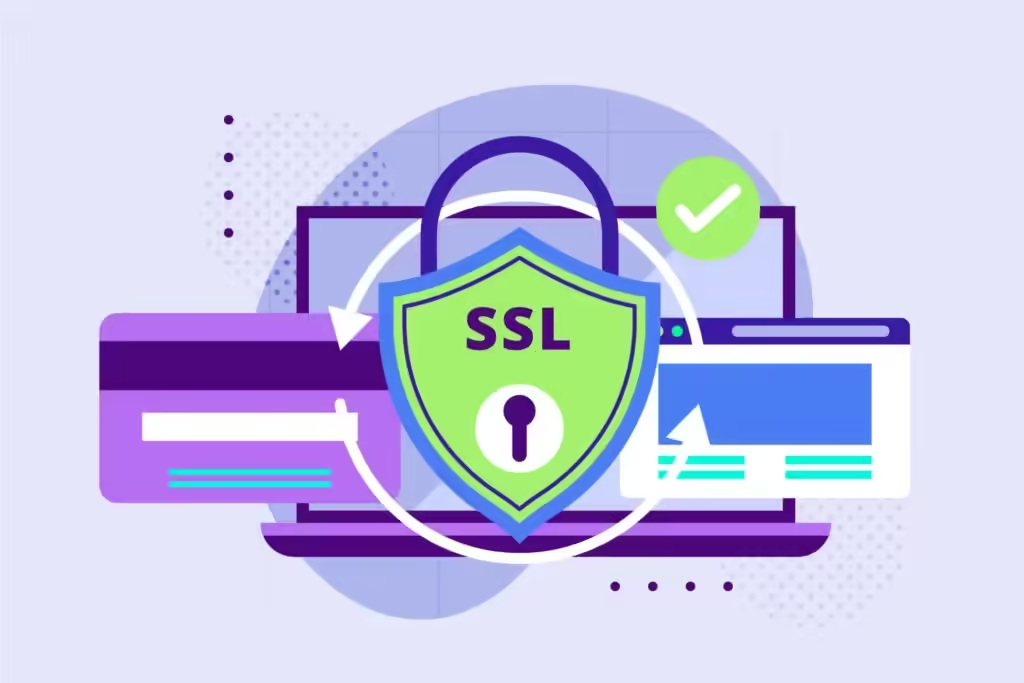

To fully understand why this element is so important, we must first explain its role. SSL stands for Secure Socket Layer. It is a cryptographic technology whose main purpose is to create a secure, encrypted connection between the server hosting the website and the user's web browser.
A Brief History and Evolution to TLS
SSL technology was developed in the 1990s by Netscape. Its goal was to ensure the confidentiality and integrity of data on the Internet. Over the years, the protocol has undergone numerous modifications and improvements. Its successor, SSL, is now the standard. TLS (Transport Layer Security). Although the name of the technology has formally changed and TLS is the one in use today, the name "SSL certificate" has become so ingrained in users' minds that it is widely used as a synonym for security certificates, even though they technically rely on the newer TLS protocol.
How Encryption Works – The Sealed Envelope Metaphor
An SSL certificate works like sending a letter in a secure, sealed envelope instead of on an open postcard. When you visit a website without SSL (HTTP), all the data you send and receive—logins, passwords, contact form data—is transmitted in plain text. Anyone with access to the transmission network (e.g., a hacker on the same Wi-Fi network) can intercept and read this data without any problem.
SSL certificate This changes the situation. It initiates a process called the "SSL handshake," during which the server and browser establish a shared, unique encryption key. From that point on, all communication between them is encrypted. Even if someone intercepts this data, they will only see a meaningless string of characters, impossible to decipher without the appropriate key.
The difference between HTTP and HTTPS
The presence of an SSL certificate on a website changes the beginning of its address from http:// to https://. This additional "s" stands for "secure." It's a simple but crucial signal to users and search engines that the connection to the site is secure.
The main reasons why an SSL certificate is absolutely necessary


There are many arguments in favor of installing a certificate, covering technical, legal and business aspects.
User data protection (encryption)
This is a fundamental function of SSL. Any website that asks users to provide any information—from a simple contact form, to a login form, to credit card details in an online store—must protect it. An SSL certificate ensures that this sensitive information is secure during transmission and doesn't fall into the wrong hands.
Building trust and credibility (authentication)
In addition to encryption, an SSL certificate also serves as an authentication function. It confirms that the website you're connecting to is indeed who it claims to be. The certificate issuer verifies the identity of the domain owner (and, in the case of more expensive certificates, the entire organization). The padlock icon in a browser signals to the user: "You're in the right, secure place." A website without this symbol immediately loses credibility.
Legal requirement and GDPR compliance
The General Data Protection Regulation (GDPR) requires data controllers to implement appropriate technical and organizational measures to protect their data. Encrypting data transmissions using the HTTPS protocol is considered one of the basic technical measures. Processing personal data on a website without an SSL certificate is a clear violation of GDPR principles and may result in significant financial penalties.
Impact on Google positioning (SEO)
Back in 2014, Google officially confirmed that having an SSL certificate and using the HTTPS protocol are ranking signals. This means that secure sites have an advantage in search results over those without. While this isn't the most important factor, in competitive industries it can be crucial for a higher ranking.
Modern browser requirement
All leading browsers (Google Chrome, Mozilla Firefox, Safari, Edge) actively discourage the use of unsecure sites. A prominent "Not Secure" label in the address bar effectively deters users who are increasingly aware of online threats.
The condition for the operation of modern technologies
Many modern internet features and protocols require a secure HTTPS connection to function. Examples include HTTP/2, which significantly speeds up page loading, and browser APIs like Geolocation (location sharing) and Service Workers (enabling web applications to run offline). Without SSL, you won't be able to take advantage of these technologies.
Types of SSL certificates – which one to choose?



Certificates differ in the level of verification of the domain owner's identity, which translates into the level of trust and the way they are presented in the browser.
DV (domain validation) certificate – basic protection for everyone
This is the most popular and simplest type of certificate. The verification process is automated and consists solely of confirming that the person requesting the certificate has control over the given domain. This solution is ideal for blogs, showcase websites, and small portals. It provides full encryption (a padlock) but does not provide information about the site's owner. This category includes the popular, free Let's Encrypt certificate.
OV (organization validation) certificate – for companies and portals
In this case, the certification authority (CA) verifies not only the domain but also the applicant's company details (name, address, legal status). OV certificates offer a higher level of trust. By clicking the padlock in the browser, the user can view the verified organization's details. This is a good choice for businesses, news portals, and small e-commerce stores.
EV (extended validation) certificate – the highest level of trust
An EV certificate requires the most rigorous verification process for company data. For years, it was distinguished by displaying the full company name in a green bar directly in the browser window. Although most browsers have since abandoned the green bar, these certificates still offer the highest level of assurance and are the standard in the financial sector, banking, and large e-commerce platforms.
What happens if a website does not have an SSL certificate?
The consequences of not having an SSL certificate are serious and multifaceted.
- Visible warnings for users: The message "Unsecured" is the first and strongest blow to the image.
- Risk of data interception: You are exposing your users to Man-in-the-Middle attacks, where a hacker can eavesdrop and modify communications.
- Loss of trust and customers: A user who sees a security warning will likely leave the site and not make a purchase or leave their information.
- Worse SEO positions: Your website will rank lower in Google than your secured competitors.
- Blocked by antivirus software: Some antivirus software and corporate firewalls may block access to websites without HTTPS.
Summary – SSL certificate is not an option, it's standard
Returning to the question asked at the beginning: Is an SSL certificate necessary for your website? The answer is yes, absolutely and unequivocally. Today's internet no longer has a place for sites running on the outdated and insecure HTTP protocol.
Installing an SSL certificate is a fundamental step that impacts the security, credibility, marketing, and technological advancement of your website. It's an investment that protects your users, builds trust in your brand, and opens the door to greater online visibility. Ignoring this standard is a deliberate detriment to your business.