






For many entrepreneurs, especially at the beginning of their business journey, marketing budget appears to be one of the biggest challenges. How much money should be allocated to promotion? Where should the investment be for the best return? Should it be focused on social media, SEO, or perhaps paid advertising? Without a solid plan, marketing spending can quickly become a chaotic waste of money that fails to deliver the expected results.
A wisely planned marketing budget isn't just a dry cost calculation. It's a strategic roadmap that connects business goals with specific promotional activities and allows for conscious investment in company development. It's a tool that allows you to measure effectiveness, optimize campaigns, and make decisions based on hard data, not gut feelings. In this article, we'll guide you step-by-step through the process of creating an effective marketing budget, from defining goals, choosing resource allocation methods, and analyzing and adapting the plan to changing realities.
Step 1: Defining business and marketing goals


Before you start counting dollars, you need to know what you want to achieve. Every marketing expense should be directly tied to a specific business goal. Without this step, the entire process loses its meaning. Your goals should align with the methodology. SMART, That is:
- SSpecific: Precisely defined (e.g., "increase sales of product X" rather than "improve sales").
- MMeasurable: Capable of being measured using numbers (e.g., "increase sales by 15%").
- AAttractive/Ambitious: Challenging but realistic.
- RRealistic: Achievable with available resources.
- TTime-bound: Specified within a specific time frame (e.g., "within the next quarter").
Examples of marketing goals linked to business goals:
- Business purpose: Revenue growth of 20% per year.
- Marketing purpose: Generate 500 new qualified sales leads (MQL) within 6 months.
- Business purpose: Entering a new regional market.
- Marketing purpose: Building brand recognition at the level of 30% among the target audience in a new region within a year.
- Business purpose: Increased customer retention by 10%.
- Marketing purpose: Reducing the churn rate by 5% through the implementation of a loyalty program and email marketing campaigns.
Step 2: Understanding the market and target audience


You can't effectively budget without knowing who you're talking to and where those people spend their time. This step requires analysis and answers to key questions:
- Who is your ideal customer? (Creating a so-called marketing persona).
- Where do your potential customers look for information about products or services like yours? (Google search, social media, industry forums, blogs?).
- What marketing channels are most effective in your industry?
- What is your competition doing? What channels does it invest in? Analyzing competitor activity can be a valuable source of inspiration and benchmarking.
Understanding these aspects will allow you to direct your budget to those channels that have the greatest potential to reach the right people.
Step 3: Choosing a budgeting method


There are several popular methods for determining the overall amount a company will spend on marketing. It's best to combine several of them to get the most realistic picture possible.
Percentage of revenue method
This is one of the simplest and most commonly used methods. It involves allocating a fixed percentage of total revenue (past or projected) to marketing. Typically, companies allocate between 51% and 151% of their revenue, depending on their industry, stage of development, and goals. New companies that need to aggressively build their position often invest significantly more.
The "competitive level" method„
It involves analyzing the marketing spend of your main competitors and trying to match them. While it provides a baseline, it's a risky strategy. It doesn't take into account your unique goals, and data on competitive budgets is often only an estimate.
Task-based method
This is the most strategic and recommended approach. The process is as follows:
- You define your marketing goals (e.g. acquiring 100 new customers).
- You identify the specific activities and channels needed to achieve these goals (e.g., Google Ads campaign, content marketing, Facebook activities).
- You estimate the costs of each of these activities (e.g. cost of a click on an ad, cost of preparing an article).
- You add up the costs of all planned activities to obtain an overall budget.
This approach ensures that every zloty spent has its justification in the strategy.
The "all we can afford" method„
Often used by startups and small businesses, it involves allocating all funds remaining after covering essential operating costs to marketing. This method is highly flexible, but lacks a strategic framework.
Step 4: Allocating funds to specific channels and activities

Once you have a general amount in mind, you need to divide it wisely. Your marketing budget should take into account a wide range of costs.
What should be included in the budget?
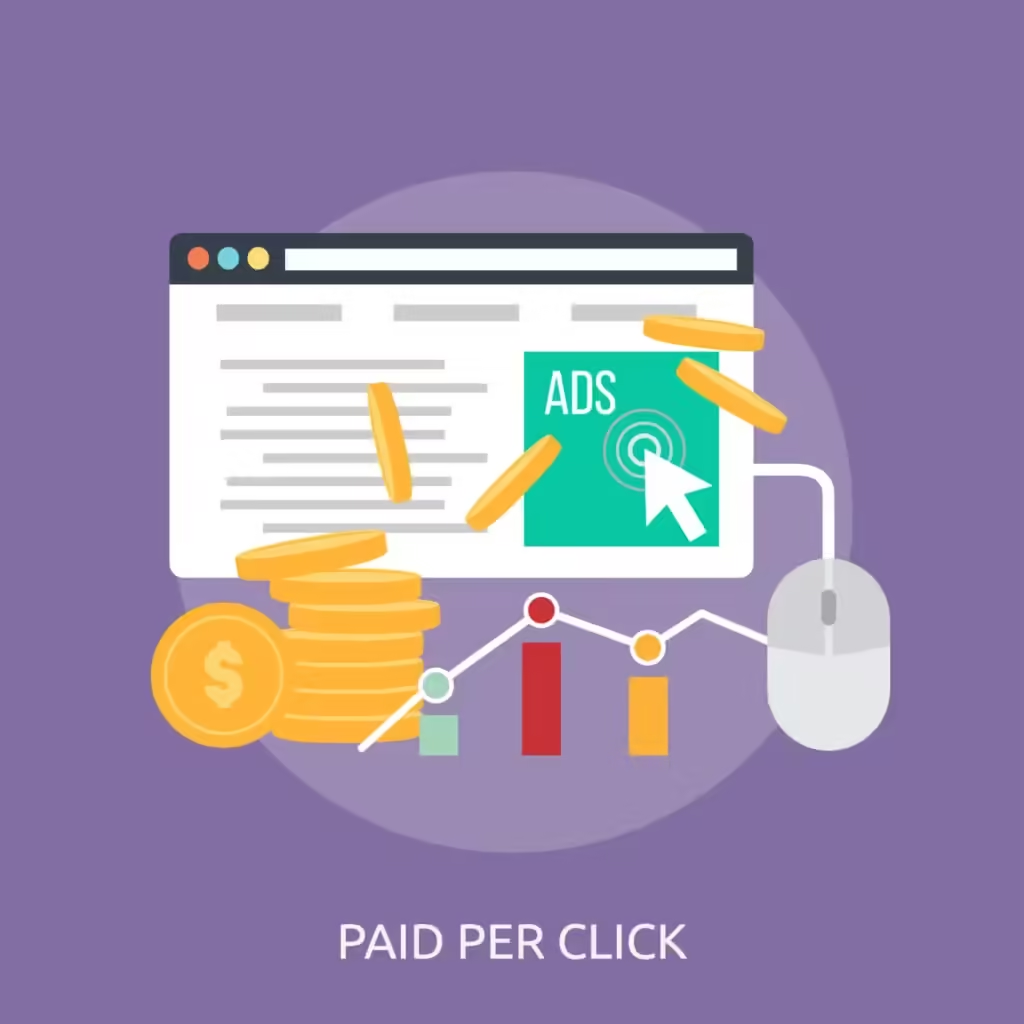
- Paid advertising (performance marketing):
- Google Ads (search ads, display campaigns, YouTube).
- Social Media Ads (Facebook, Instagram, LinkedIn, TikTok).
- Other forms of online advertising (e.g. native advertising).
- Content marketing and SEO:
- Cost of creating content (blog articles, e-books, videos, graphics) – remuneration for copywriters and graphic designers.
- SEO tools (e.g. Ahrefs, Senuto).
- Link building activities.
- Social media (organic activities):
- Management and analytics tools (e.g. NapoleonCat, Buffer).
- Cost of creating dedicated content.
- Marketing software and tools:
- Email marketing and automation systems (e.g. GetResponse, MailerLite).
- CRM (Customer Relationship Management) platforms.
- Analytical tools.
- Human resources:
- Salaries for the internal marketing team.
- Costs of cooperation with marketing agencies, freelancers, consultants.
- Other costs:
- Participation in industry fairs and conferences.
- Creation of printed materials (leaflets, catalogs) if they are part of the strategy.
The 70-20-10 rule A popular budget allocation model is the 70-20-10 rule:
- 70% budget allocate it to proven, reliable activities that are already bringing results (e.g. Google Ads campaigns that generate sales).
- 20% budget invest in new but promising channels that have the potential to become your main source of customers in the future (e.g. developing a YouTube channel).
- 10% budget reserve it for pure experiments – testing completely new channels, formats or tools (e.g. a TikTok campaign, if your target group might be there).
Step 5: Measure, analyze and optimize


A marketing budget isn't set in stone. It's a living document that needs to be regularly reviewed and adjusted. Measuring the effectiveness of individual activities is key.
Key performance indicators (KPIs) worth tracking:
- Cost Per Lead (CPL): How much does it cost you to contact a potential client?
- Customer Acquisition Cost (CAC): How much does it cost you to convince a lead to make a purchase?
- Customer Lifetime Value (CLV/LTV): How much revenue does the average customer generate over the course of their relationship with your company?
- Return on Marketing Investment (ROMI): The most important indicator, showing how much revenue is generated by each zloty spent on marketing.
Regular (e.g., monthly or quarterly) analysis of these metrics will allow you to identify which channels are performing best and which are merely "budget sinks." Based on this, you can dynamically reallocate resources, abandoning ineffective activities in favor of those that deliver the best return on investment.
Summary: Budget planning as an ongoing process
Smart marketing budget planning is one of the key competencies that distinguishes dynamically growing companies from those that stagnate. It's a process that requires strategic thinking, an analytical approach, and a willingness to continually optimize. Remember, there's no one-size-fits-all template. The ideal budget is one tailored to your unique goals, capabilities, and industry specifics. Treat it as a compass pointing the way to sustainable development, not a rigid corset that limits your options.
Część cyklu: Top 5 Digital Marketing Trends for 2025