





Entry
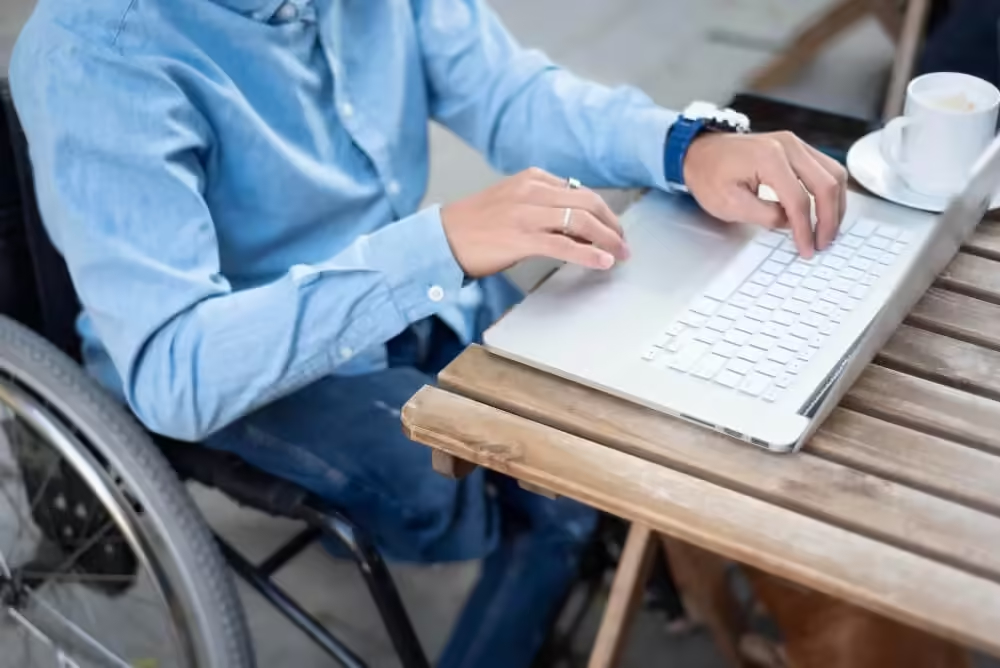
The world of the internet is where we currently spend 80% of our time, both at work and in our free time. For some, however, the world of the internet and universally accessible digitization is their only window to the world. People with various disabilities can now participate in life just as effectively as people without disabilities, thanks to the ever-growing technology industry and the resulting conveniences. We can no longer imagine standing for hours at a bank or post office to send a transfer (of course, such a necessity sometimes occurs, but thanks to the digital accessibility of such institutions, the queues are no longer so terrifying). We don't even have to go to the office to register our own company. We use ATMs, ticket machines, and the internet. All these conveniences also provide a window to the world for people with disabilities, who, with the right tools at their disposal, can take advantage of the benefits of the modern world.
When we talk about digital accessibility, we usually think of people with disabilities such as blindness, deafness, or limited mobility, but we completely forget that these features also come in handy for able-bodied people in the most unexpected situations. Using them can be helpful on a crowded tram while watching a movie, or when our mouse breaks and we can no longer use it. In such cases, the ability to navigate a website solely using the keyboard becomes essential.
So the question arises what we can do to make the tools we currently use or those we intend to introduce to the market more accessible.
What is digital accessibility?
To make the website accessible to people with disabilities, several important issues should be noted.
Firstly, the website should be designed to be accessible to people using screen readers. Ensure the page structure is clear, use appropriate headings and tags, and mark graphic elements with alternative descriptions.
Secondly, care should be taken to ensure appropriate color contrast and font size and layout to ensure the text is legible to people with various types of visual impairments.
Thirdly, it is important to enable navigation on the site using a keyboard, as well as provide alternative methods of interaction, such as gestures or voice commands.
Additionally, it is worth ensuring automatic accessibility of multimedia content for blind or visually impaired people by adding subtitles to videos or transcripts to podcasts.
At last, the content management system should be friendly to people with disabilities, enabling them to easily manage content and access appropriate editing tools.
It's also important for websites to be intuitive and easy to use, which improves the user experience not only for people with disabilities but also for all users. This means that the European Accessibility Act not only protects the rights of people with disabilities but also ensures the convenience and satisfaction of all users.

Legal regulations
Currently, the Polish legal system includes the Act on Digital Accessibility of Public Entity Websites and Mobile Applications. This is the first Polish law that addresses digital accessibility in its entirety and requires public entities to ensure digital accessibility and publish an accessibility declaration. It implements Directive (EU) 2016/2102 of the European Parliament and of the Council of 26 October 2016 on the accessibility of public sector bodies' websites and mobile applications.
The Act stipulates that a website and mobile application are digitally accessible if they meet specific requirements. These are presented in a table that is an annex to the Act. This table is equivalent to the guidelines WCAG (Web Content Accessibility Guidelines) at level AA (with minor restrictions). Websites that operate solely for the needs of a public entity (e.g., intranet, extranet) must also be digitally accessible and have their own accessibility declarations.
Websites of public entities must comply with the requirements of this Act from September 23, 2020, and mobile applications from June 23, 2021.
In 2025, the European Accessibility Act comes into force (EAA – European Accessibility Act). This document specifies the accessibility requirements for selected products and services. Its official name is Directive (EU) 2019/882 of the European Parliament and of the Council of 17 April 2019 on the accessibility requirements for products and services.
The right to accessibility is no longer just a requirement for public institutions. Thanks to the European Accessibility Act (EAA), it will also cover a wide range of businesses across various industries from June 2025. According to its provisions, the obligation to ensure accessibility will also extend to industries dealing with computer technology, e-commerce, banking, and passenger transport.

Legislative changes and the e-commerce industry
Adapting the e-commerce industry to the new requirements will require significant commitment from the entire industry, but there is a good chance that the effort will not be wasted and the entire industry can benefit significantly.
The British study "Click Away Pound" shows that people with disabilities are often discouraged from shopping online due to website accessibility issues. Most people abandon sites they find difficult to use in search of more user-friendly options. However, respondents are willing to spend more on sites that are accessible and easy to use. Therefore, businesses can benefit from adapting their websites to the needs of people with disabilities, which can provide significant financial benefits.
More accessible websites also mean a greater number of potential visitors to those websites.
Summary
Website accessibility for people with disabilities is crucial, as it allows them to fully participate in social, professional, and cultural life. With appropriate technological solutions, people with disabilities can access various types of information, services, and products online, increasing their independence and autonomy.
The European Accessibility Act is an important step towards ensuring the full integration of people with disabilities into society. It makes websites more user-friendly for all, contributing to a more open and equal online environment. Therefore, it's important to ensure that websites are accessible to everyone, regardless of their individual needs and limitations, for mutual benefit.